




-
You have no items in your shopping cart.


Short answer: Eames Lounge Chair problems fall into two groups: structural problems, such as detached armrests and loose buttons, and leather damage, such as mould, dirt, holes, colour loss, peeling and wear. In our experience, both can be repaired without re-upholstering the whole chair or buying a new one. Send us photos on WhatsApp for a quote. Cleaning is completed within one day, while serious damage is repaired in our workshop, usually within 2 to 3 weeks. Below are 5 real Eames chair cases handled by the Furniture Clinic Hong Kong team, including one replica.
The Eames Lounge Chair (model 670) and Ottoman (model 671) were designed by Charles and Ray Eames and launched by Herman Miller in 1956. They are still in production today and are part of the permanent collection of the Museum of Modern Art (MoMA) in New York (sources: Herman Miller, Wikipedia).
The chair is made of three moulded plywood shells (headrest, backrest and seat) fitted with leather cushions (source: Wikipedia). The plywood shells, aluminium base and overall frame usually last for many years. The first things to show problems tend to be the leather surface, the glued armrest joints and the buttoned cushions. In other words, most Eames chair problems are local and do not mean the whole chair is beyond use.
The designers wanted the chair to have “the warm, receptive look of a well-used first baseman’s mitt” (source: Herman Miller). Natural signs of use on the leather are therefore normal. What does need attention is damage that keeps getting worse, such as detached armrests, mould, holes, colour loss and heavy wear.
The leather on Eames chairs and on car seats mostly has a pigment coating on the surface, so the two are similar in nature; the main difference may simply be the thickness of the coating. In our experience, if it has to be classified, Eames chair leather is closest to pigmented leather. This coating protects the leather fibres underneath. What wears the coating down is mainly dirt and skin oils combined with everyday friction. With regular cleaning and care, and by dealing with damage early, our experience is that the leather can last for decades. Well-kept original leather seats in classic cars are the best example.
Herman Miller also describes the Eames Lounge Chair as an heirloom piece that, with good care, can last for decades and even generations (source: Herman Miller).
When an Eames chair has a problem, the first step is to work out which type it is, because the causes and repair methods are completely different.
| Type | Common problems | Main causes | Repair approach |
|---|---|---|---|
| Structural problems | Detached or loose armrests, loose or missing buttons | The armrests are originally glued in place and come apart after years of load and adhesive ageing; the buttoned points are pulled by sitting pressure over time, so buttons work loose | Re-glue and re-tighten the screws in their original positions; reinstall buttons, and replace any that are lost |
| Leather damage | Dirt, mould, holes, edge colour loss, cushion wear | Daily use, friction, humidity, scratches from sharp objects, wear of the surface coating | Cleaning, mould removal, fibre strengthening, filling, re-colouring, protective finishing |
A chair can have both types of problem at the same time. For example, a chair with a detached armrest often also has worn cushions, and both can be dealt with in one go.
Furniture Clinic carries out every leather cleaning and repair step with its own UK-made products, the same range sold in our online shop.
| Step | Product used | Purpose |
|---|---|---|
| Cleaning | Leather Ultra Clean | A water-based cleaner with no solvents or abrasives that removes dirt built up on the surface and in the grain; the leather of the whole chair is cleaned, including areas that do not need repair |
| Removing the old coating | Leather Prep | Used only on areas that need re-colouring, to remove old, loose coating and surface oils so the new colour bonds firmly |
| Mould removal | Mould Remover | Formulated for leather, fabric and other surfaces to kill and remove mould spots |
| Strengthening leather fibres | Leather Binder | Used where wear has exposed the leather fibres; it penetrates and bonds the fibres together, making the repair more durable |
| Filling | Leather Flexifil | Fills dents, cracks and heavily worn areas; it stays flexible when dry and can be sanded smooth |
| Colouring | Leather Colourant | A UK leather colourant that is highly flexible and hard-wearing, mixed to match the original colour |
| Protective finishing | Leather Finish | A final clear coat that is hard-wearing and water-resistant and seals in the colour |
| Everyday care | Leather Protection Cream | Nourishes the leather and forms a protective layer that makes it harder for stains to soak in |
| Problem | Type | Common location | Repairable? | Main repair method | Suitable for DIY? |
|---|---|---|---|---|---|
| Detached or loose armrest | Structural | Joint between armrest and plywood shell | Yes, very common | Re-glue and re-tighten in the original screw holes | Professional repair recommended |
| Loose or missing buttons | Structural | Buttoned points on seat and back cushions | Yes | Reinstall buttons; replace any that are lost | Professional repair recommended |
| General dirt, white leather turning grey or yellow | Leather | Seat, back, armrests | Yes | Deep leather cleaning and protection | Light dirt: DIY possible |
| Mould on the leather | Leather | Whole chair, especially visible on dark leather | Yes | Surface mould: mould removal, cleaning and protection; pigment layer damaged: colour matching and re-colouring | Surface mould: DIY possible; damaged pigment layer: professional repair recommended |
| Armrest hole, foam exposed | Leather | Armrest top | Yes | Fibre strengthening, filling, re-colouring, protective finish | Professional repair recommended |
| Colour loss or cracking on armrest edges | Leather | Armrest front and piping | Yes | Filling, re-colouring, protective finish | Small areas: DIY possible |
| Cushion wear, scratches, pet claw marks | Leather | Seat, armrests, headrest | Yes | Filling, re-colouring, protective finish | Light scratches: DIY possible |
| Worn piping, core showing | Leather | Armrest piping, cushion edges | Yes | Fibre strengthening, filling, re-colouring, protective finish | Professional repair recommended |
| Large-scale cracking and peeling | Leather | Seat, armrests | Yes | Remove peeling layer, fibre strengthening, filling, full re-colour, protective finish | Professional repair recommended |
| General wear, uneven colour | Leather | Seat, armrests, back | Yes | Filling, full re-colour, protective finish | Professional repair recommended |
Case summary
- Problem: White leather turned grey, loose seat button
- Method: Button reinstalled, deep cleaning, conditioning
- Location: Workshop
- Result: Original white restored, button secured again
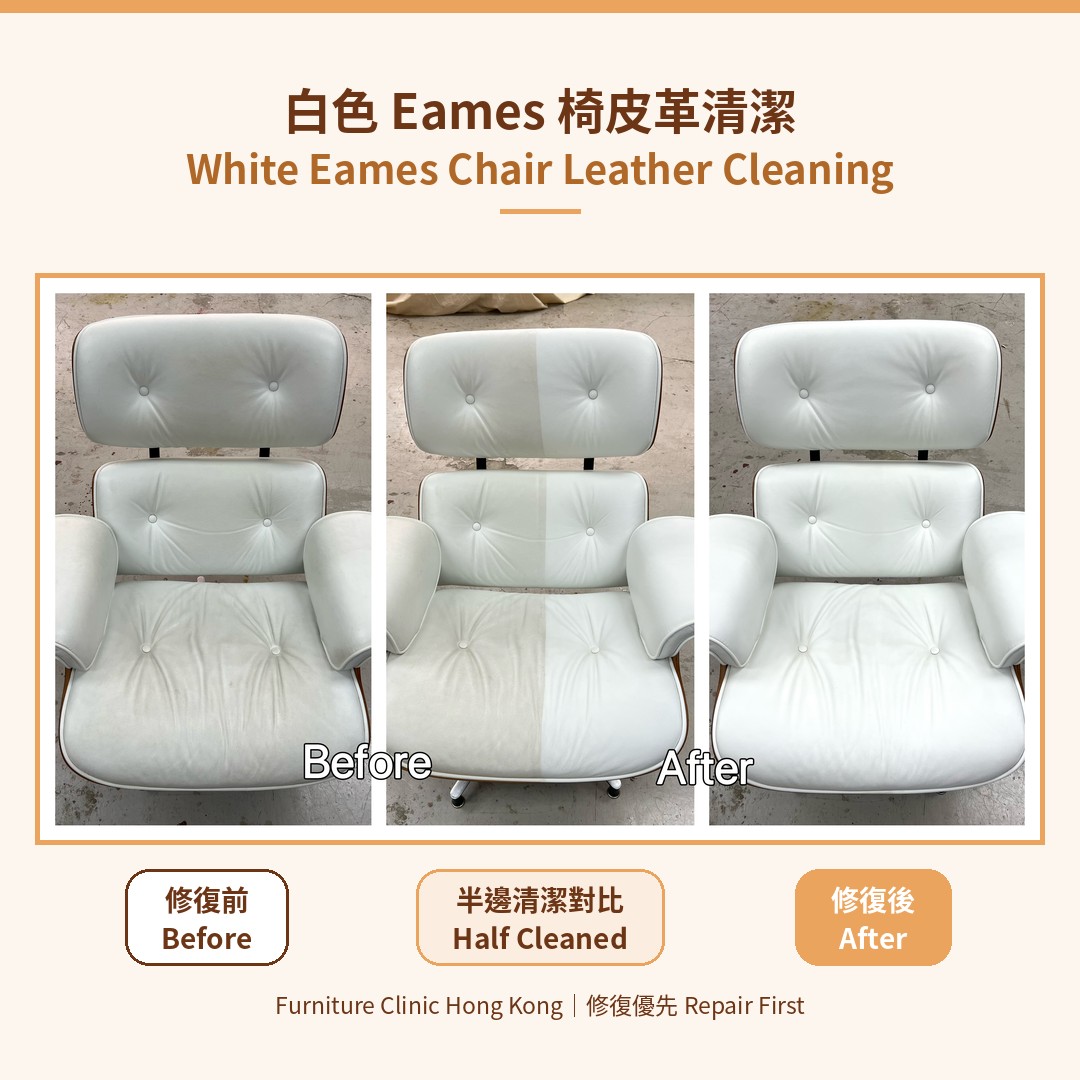
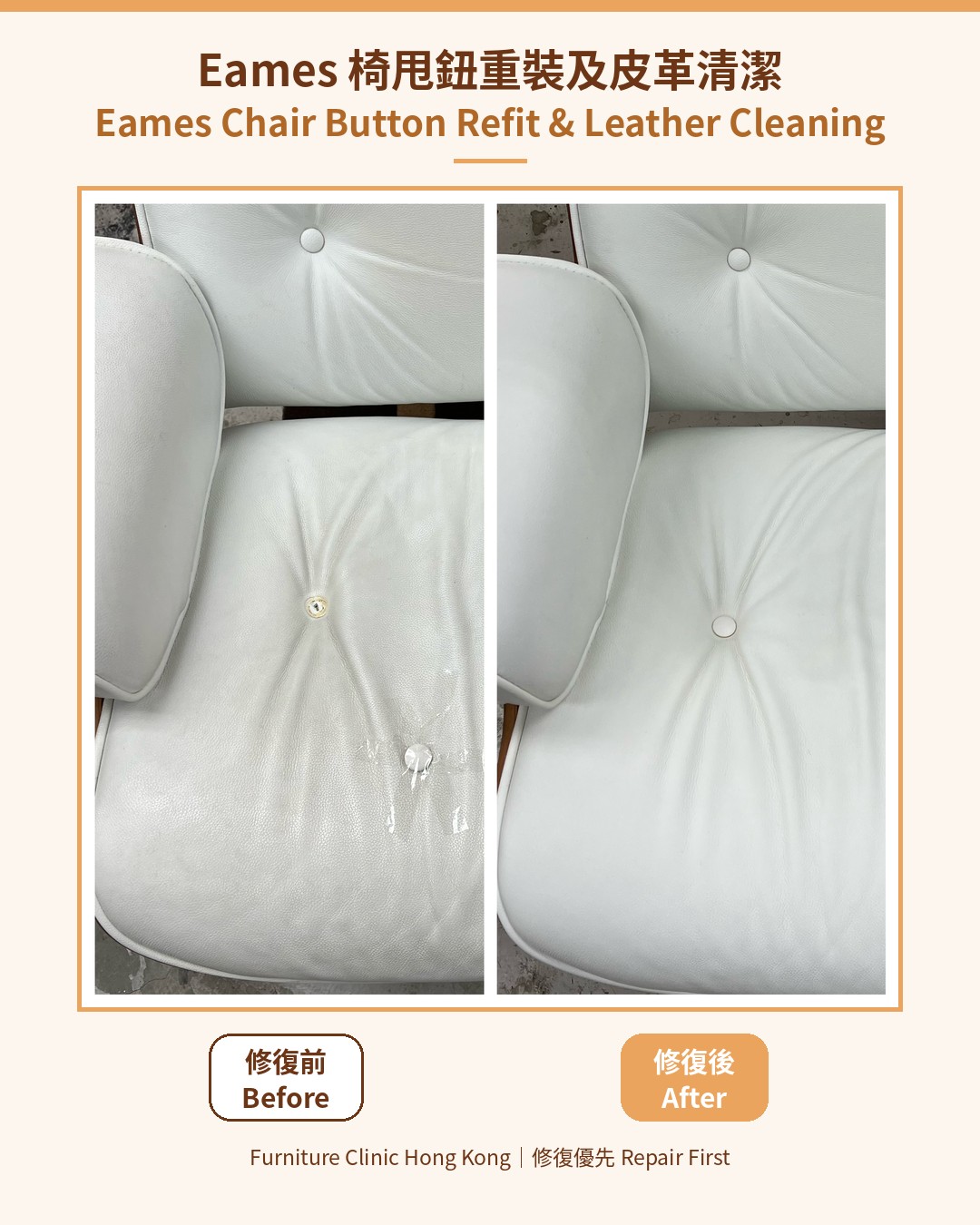
This chair had one structural problem (a loose button) and one leather problem (dirt).
Problem:
Cause:
Repair method:
Location: Workshop (the button needed reinstalling as well as cleaning)
Note: The tape visible in the “before” photo of the second image was added by the customer when sending the chair to our workshop, so that the loose button would not get lost.
Result: The middle of the first image shows a half-cleaned comparison: uncleaned on the left, cleaned on the right, and the difference is obvious. Once finished, the whole chair was back to its original white and the button was secured again.
Key point: A white leather chair turning grey is often just surface dirt and does not mean the leather has aged. If a button comes off, please keep it somewhere safe and hand it to the professional team at the time of repair. Even if the button really is lost, we can replace it for you.
Case summary
- Problem: White mould spots across the whole chair
- Method: Mould treatment, cleaning, conditioning
- Location: Workshop
- Result: Mould removed, even sheen restored
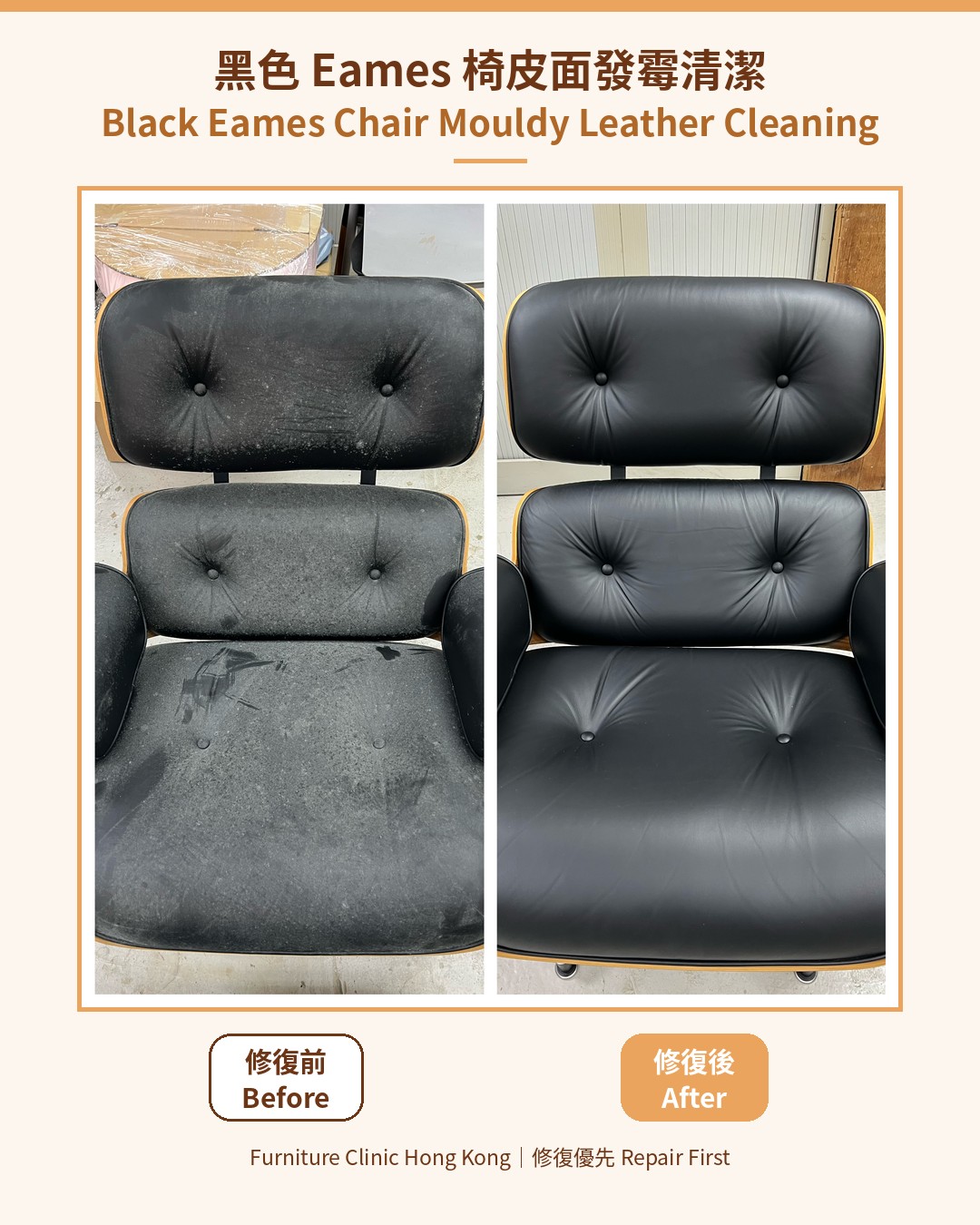
Problem: The black leather headrest, back and seat were covered in white mould spots, and the seat also had dark stains.
Cause: Hong Kong is humid. A leather chair left for long periods in a poorly ventilated room, placed against a wall or stored under a plastic cover is prone to mould. On dark leather, mould shows up as white powder and is especially noticeable.
Repair method:
Location: Workshop
Result: With the mould and stains removed, the black leather regained an even sheen, and the buttoned points and folds kept their original shape.
Key point: Mouldy leather can be repaired. First, tell the two situations apart:
The longer mould stays, the more likely it is to damage the pigment layer, so treat it as soon as you find it and improve where the chair is kept. Leather cleaning and mould removal are usually completed within one day, either on-site or in our workshop.
Case summary
- Problem: Detached armrest, armrest hole, cat scratches on the armrest and headrest, seat cushion wear
- Method: Re-gluing and fixing, removing the old coating, fibre strengthening, filling, colouring, protective finishing
- Location: Workshop
- Result: Armrest secure, leather intact, colour consistent
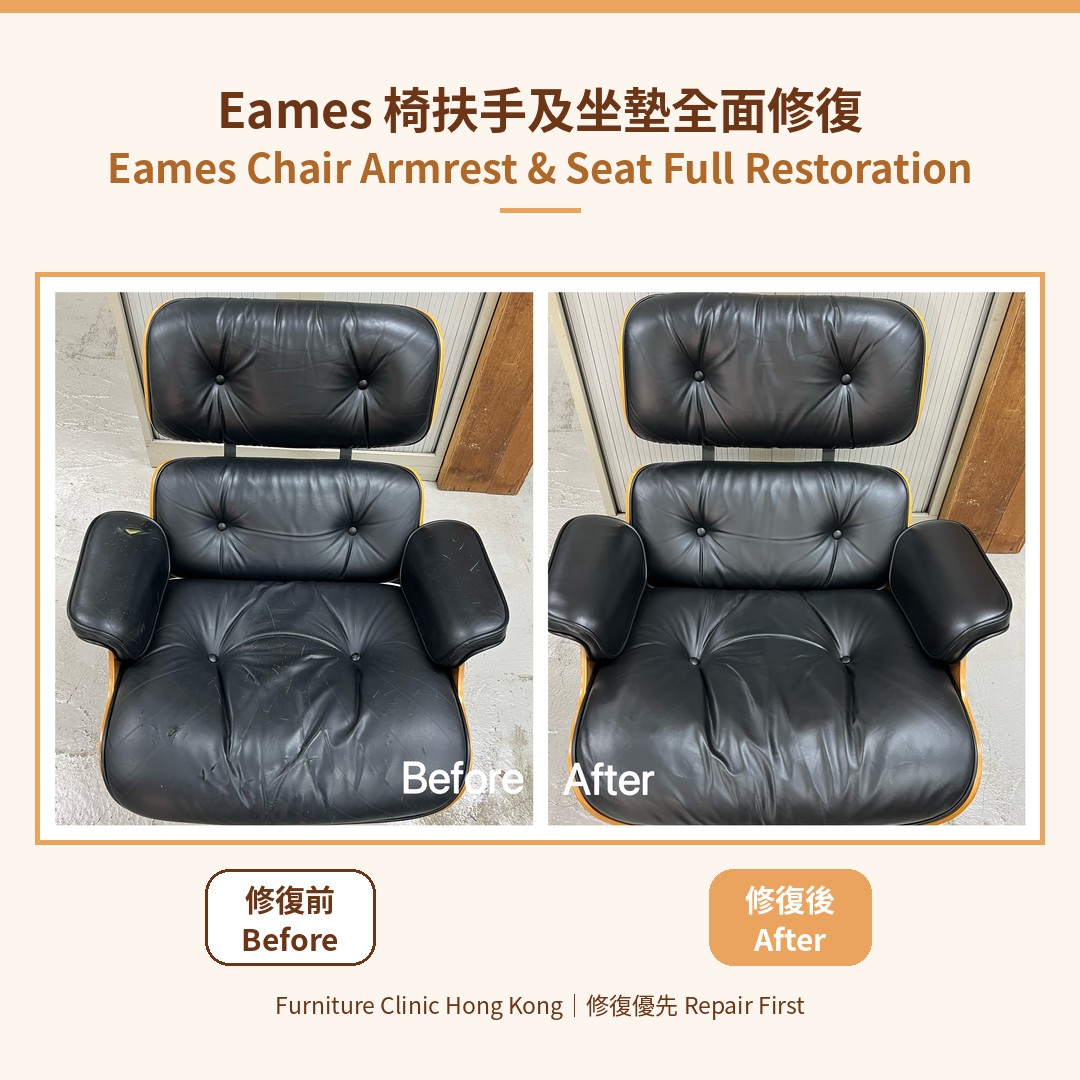
This black Eames chair had both a structural problem and several areas of leather damage, a very typical situation for an Eames chair. Because there were many steps and the work would take more than one day, the chair was brought to our workshop. The structural problem and the leather damage are explained separately below.
| Problem | Type | Location | Repair method |
|---|---|---|---|
| Detached armrest | Structural | Joint between armrest and chair body | Remove old adhesive, re-glue with a high-strength structural adhesive, re-tighten in the original screw holes |
| Armrest hole, foam exposed | Leather | Left armrest top | Fibre strengthening, filling, re-colouring, protective finish |
| Armrest scratches and wear | Leather | Both armrests | Filling, re-colouring, protective finish |
| Seat cushion wear and scratches | Leather | Seat cushion | Fibre strengthening, filling, full re-colour, protective finish |
| Cat scratches | Leather | Right armrest top, headrest | Fibre strengthening, filling, re-colouring, protective finish |
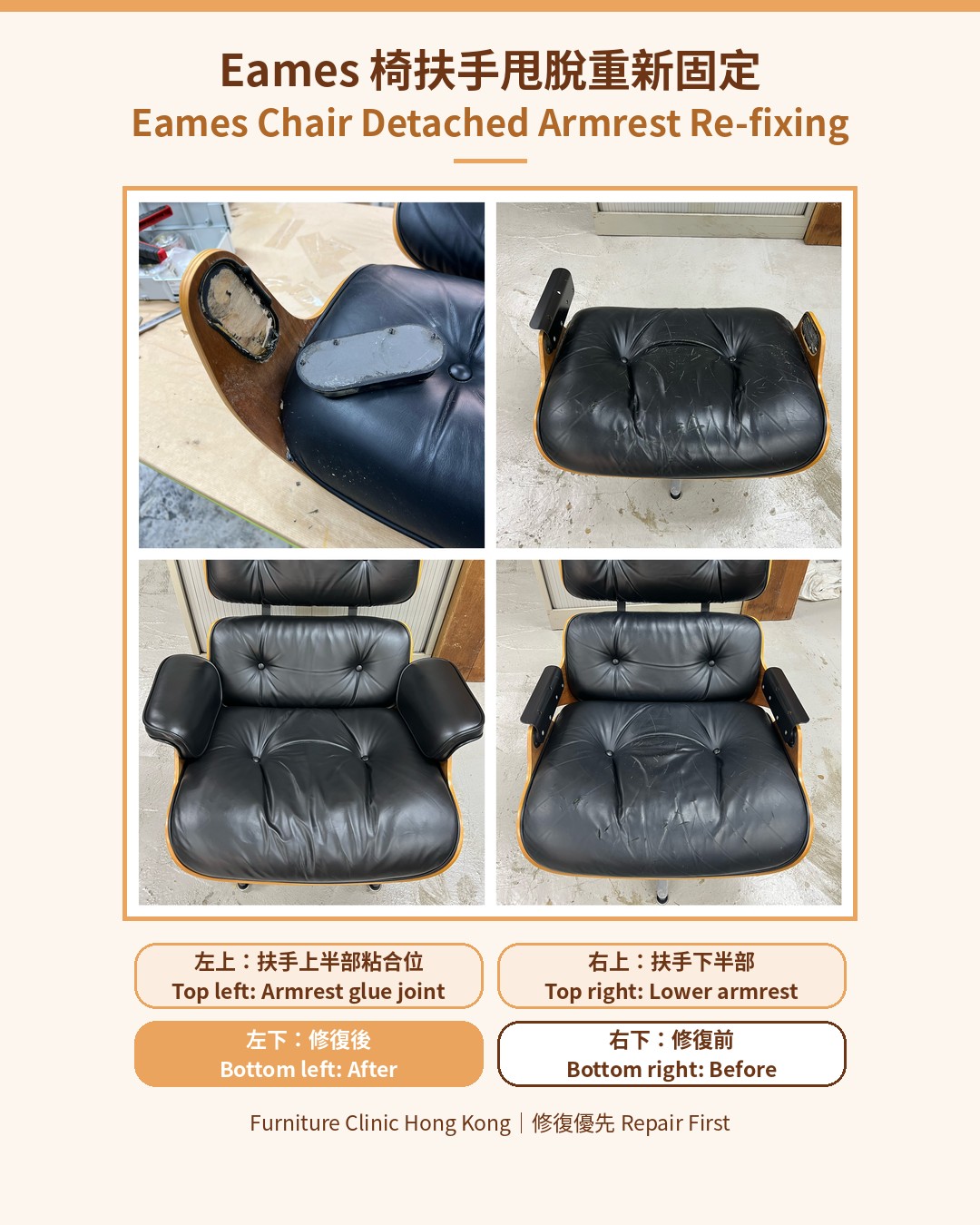
Problem: Under load, the armrest had separated from the chair body. The top-left photo shows the glued joint on the upper part of the armrest, with traces of old adhesive; the top-right photo shows the lower part, where only the metal bracket remains once the armrest is removed.
Cause: Eames chair armrests are originally glued in place and then fixed with screws. Users often push on the armrests when getting up, and as the adhesive ages, the joint eventually comes apart. Load and ageing are the main causes of detached armrests, and these cases are very common.
Repair method:
Key point: A detached armrest does not mean the chair body is damaged. Usually the glued joint has simply aged, and re-gluing and fixing it is enough, with no need to replace the armrest or the chair body. Because the joint has to take the force of people getting up for years to come, the choice of adhesive and how it is cured both affect how long the repair lasts. It is best left to a professional technician.
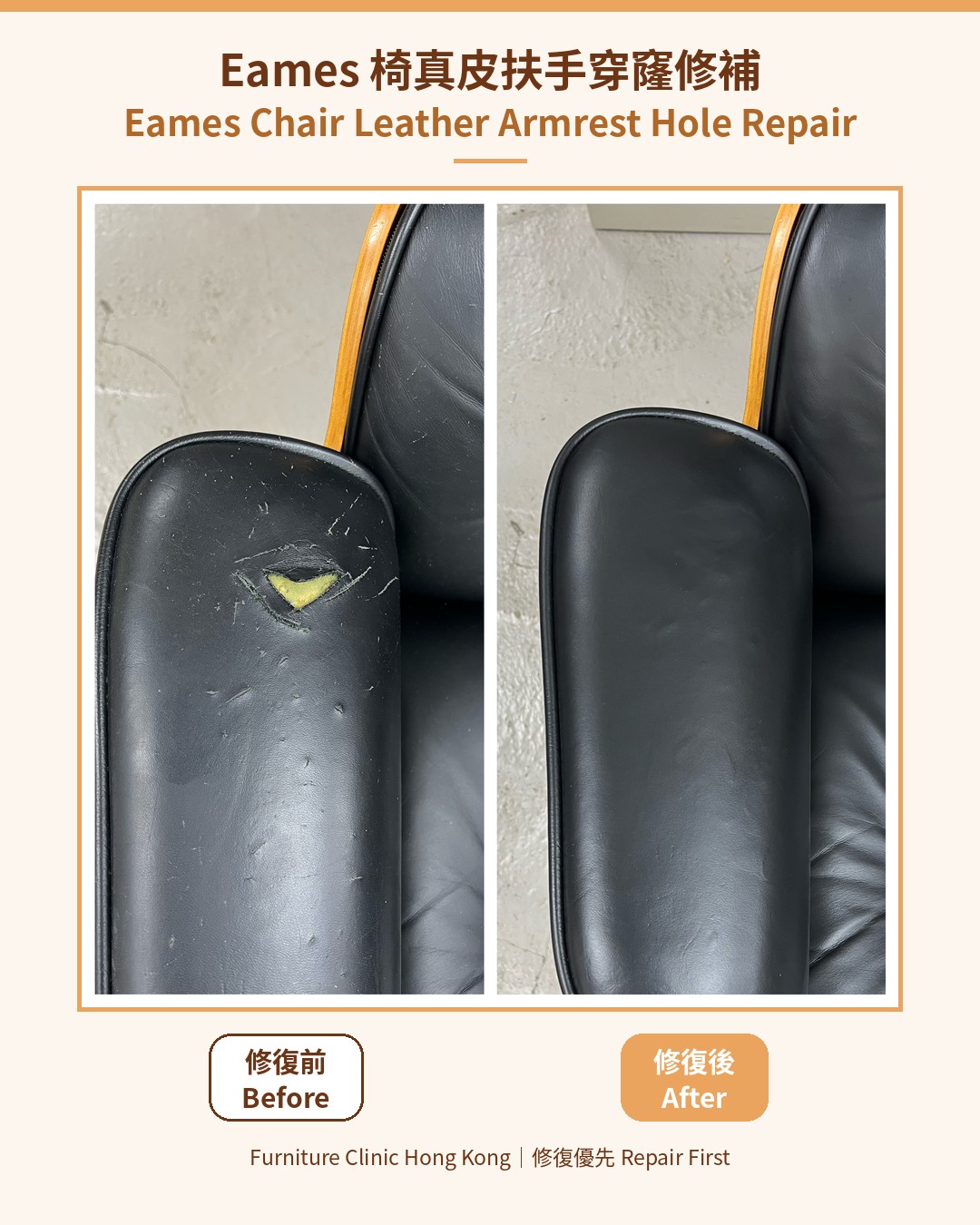
Problem: A triangular hole had opened in the top of the black leather armrest, exposing the yellow foam inside, with many scratches and white worn spots around it.
Cause: The armrests are the part of the chair most often in contact with elbows, handbags, watches and pet claws. After long-term friction or scratching by sharp objects, the leather goes from scratches to an open tear.
Repair method:
Key point: An armrest hole should be dealt with early, because the edges keep tearing under load and the exposed foam gets damaged. Pressure crushes the foam under the hole, so even after the leather is repaired, a slight dent may remain. Hand oils are also absorbed into the leather through the hole, which over time darkens the leather and cracks the coating.
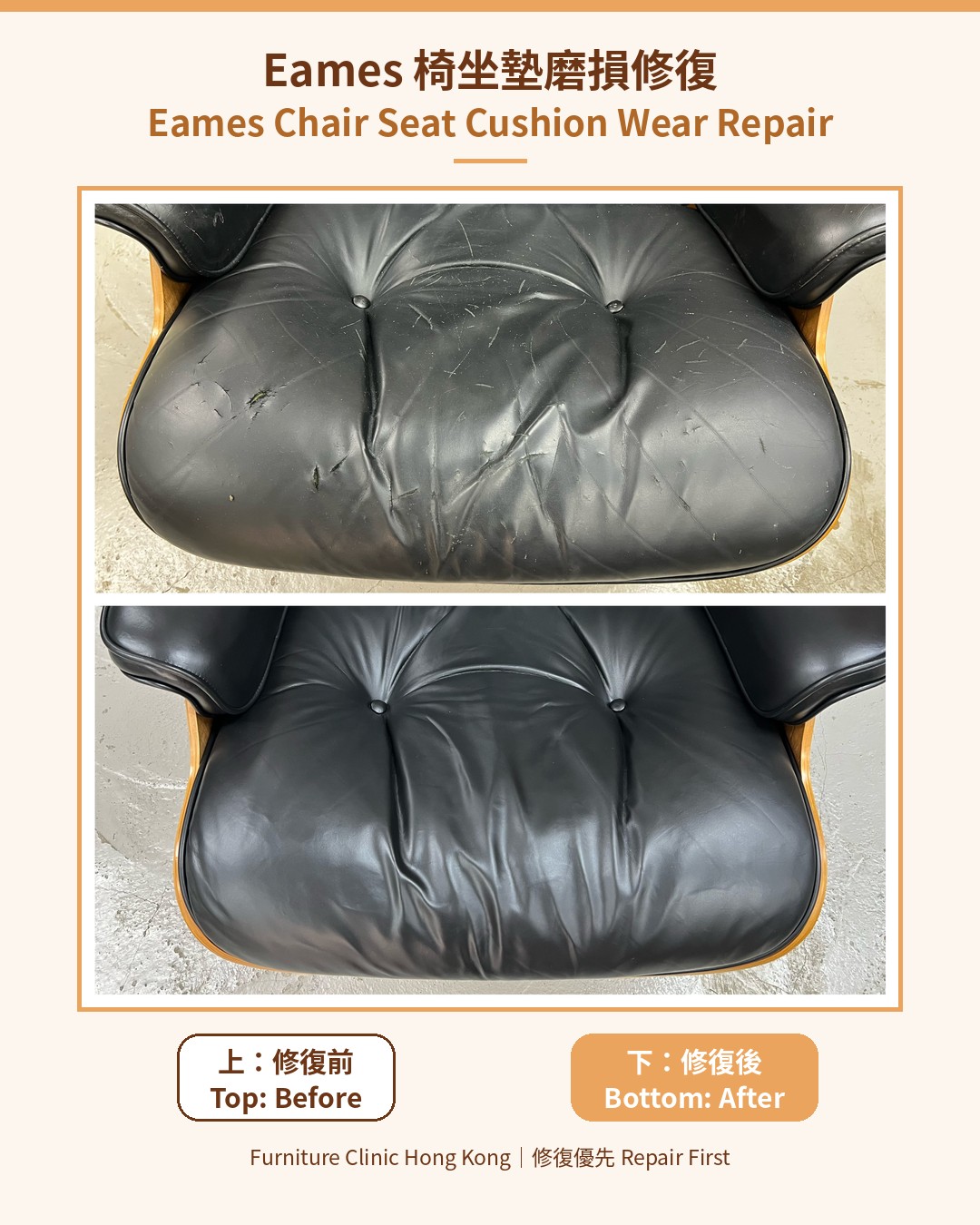
Problem: The black seat cushion was covered in scratches, worn spots and local damage, and the colour was uneven overall.
Cause: The seat cushion takes the most weight and friction. Zips and buttons on clothing, keys in pockets and pet claws all leave scratches.
Repair method:
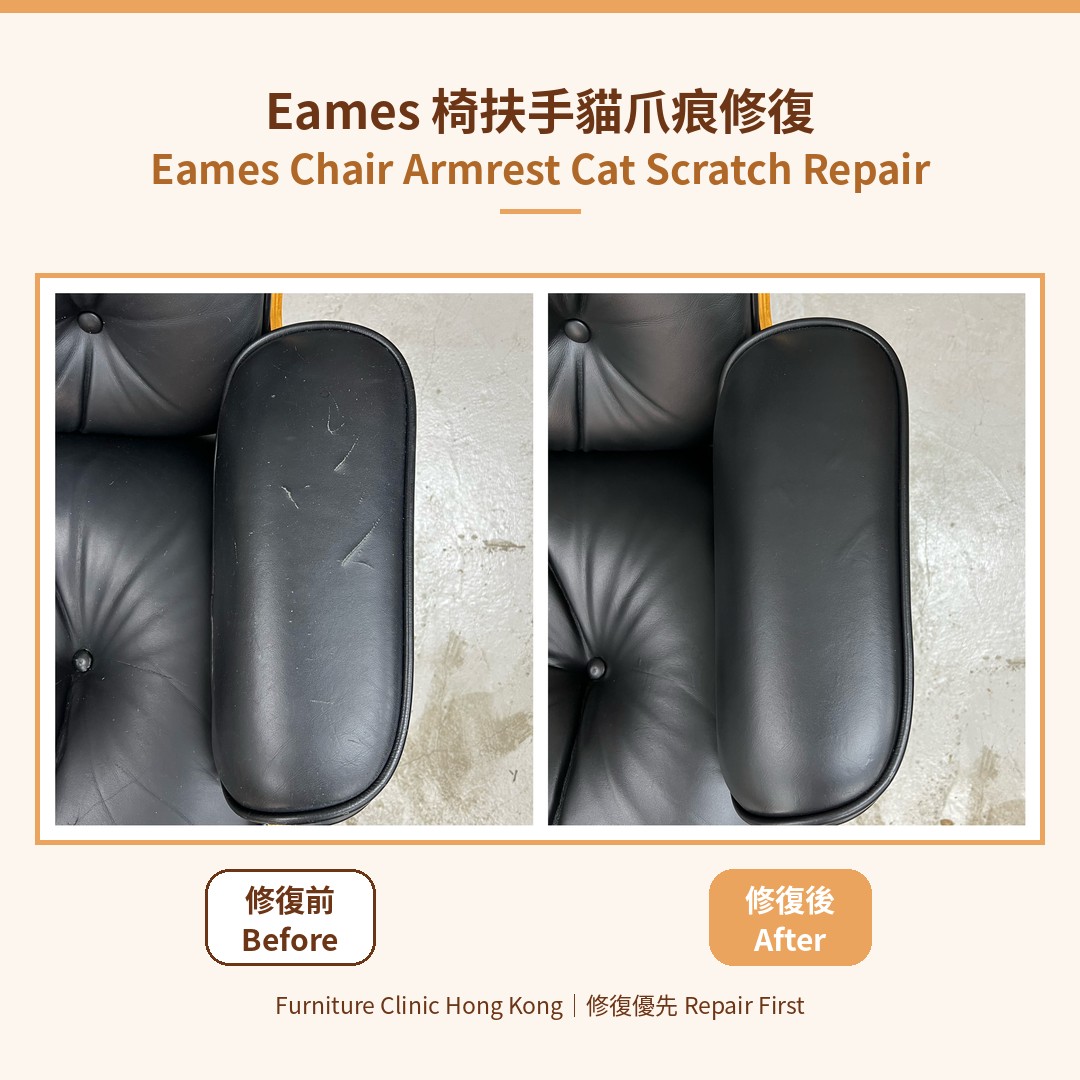
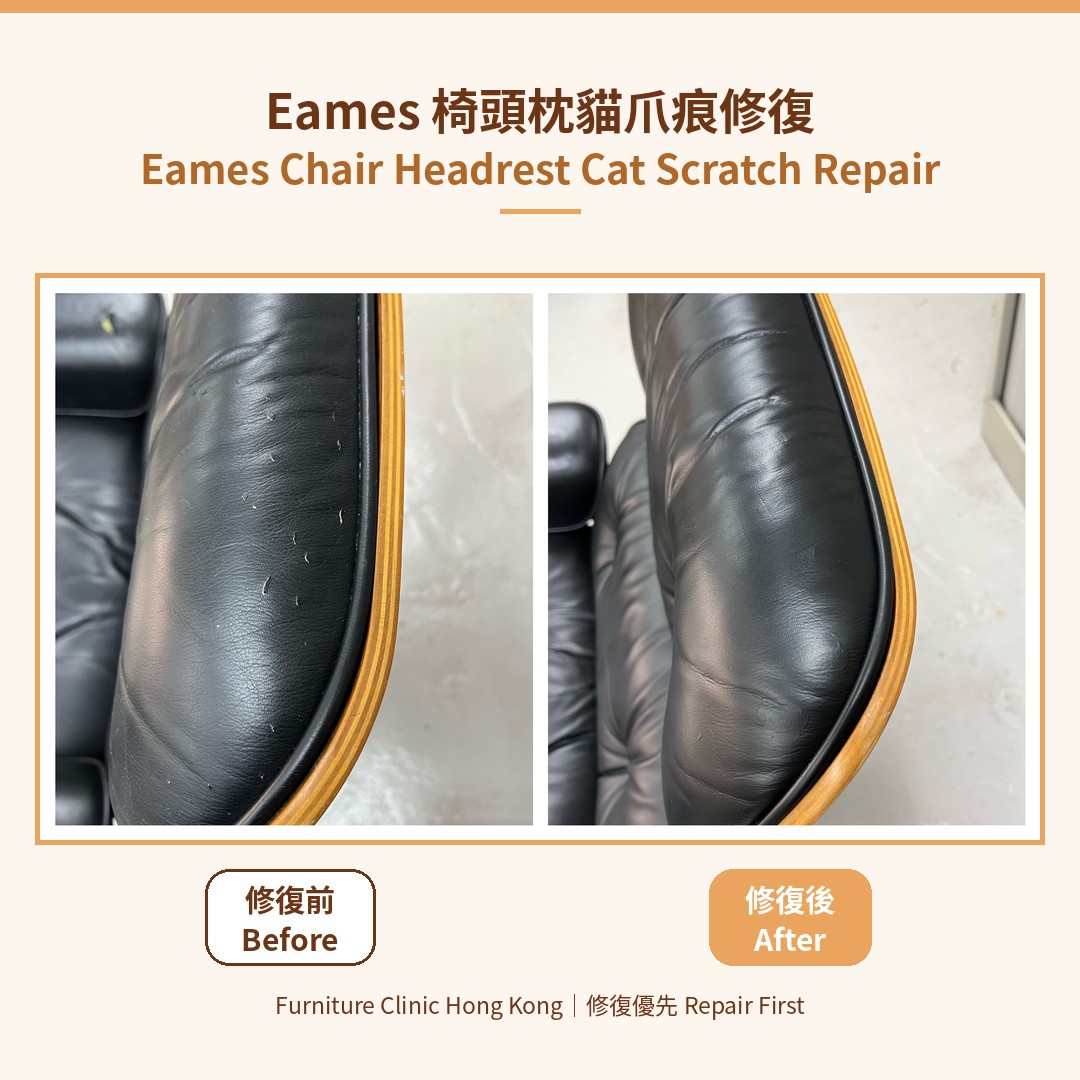
Problem: The top of the right armrest had several obvious cat scratches, where the leather surface had lifted to expose the light-coloured layer underneath. The side of the headrest at the top of the chair was also covered in small scratches and white marks.
Cause: Cats like to scratch, jump and push off from high, springy spots, and the armrests and headrest are exactly where they land and push off most often. Their claws catch the surface coating and leave white streaks.
Repair method:
Key point: Cat scratches are surface leather damage and can be repaired without re-upholstering. The sooner they are dealt with, the easier the lifted leather is to repair. If you have cats or dogs, placing a scratching post nearby helps prevent the chair from being scratched again.
Location: Workshop (more than one day of work)
Result: The armrest was reinstalled securely. Once the armrest hole, the cat scratches on the right armrest and headrest, and the seat scratches were repaired, the whole chair had a consistent colour and intact leather, while the original plywood shells, base and leather were all kept. The overall comparison at the start of this case shows the hole in the left armrest and the seat scratches before repair, both fully restored afterwards.
Key point: Structural problems and leather damage on the same chair can be repaired together. Damage in several places is no reason to decide on a new chair.
Case summary
- Problem: Cracking and colour loss on the armrest fronts, worn piping on the armrests and cushions
- Method: Removing the old coating, fibre strengthening, filling, colouring, protective finishing
- Location: Workshop
- Result: Edges restored, consistent colour across the chair
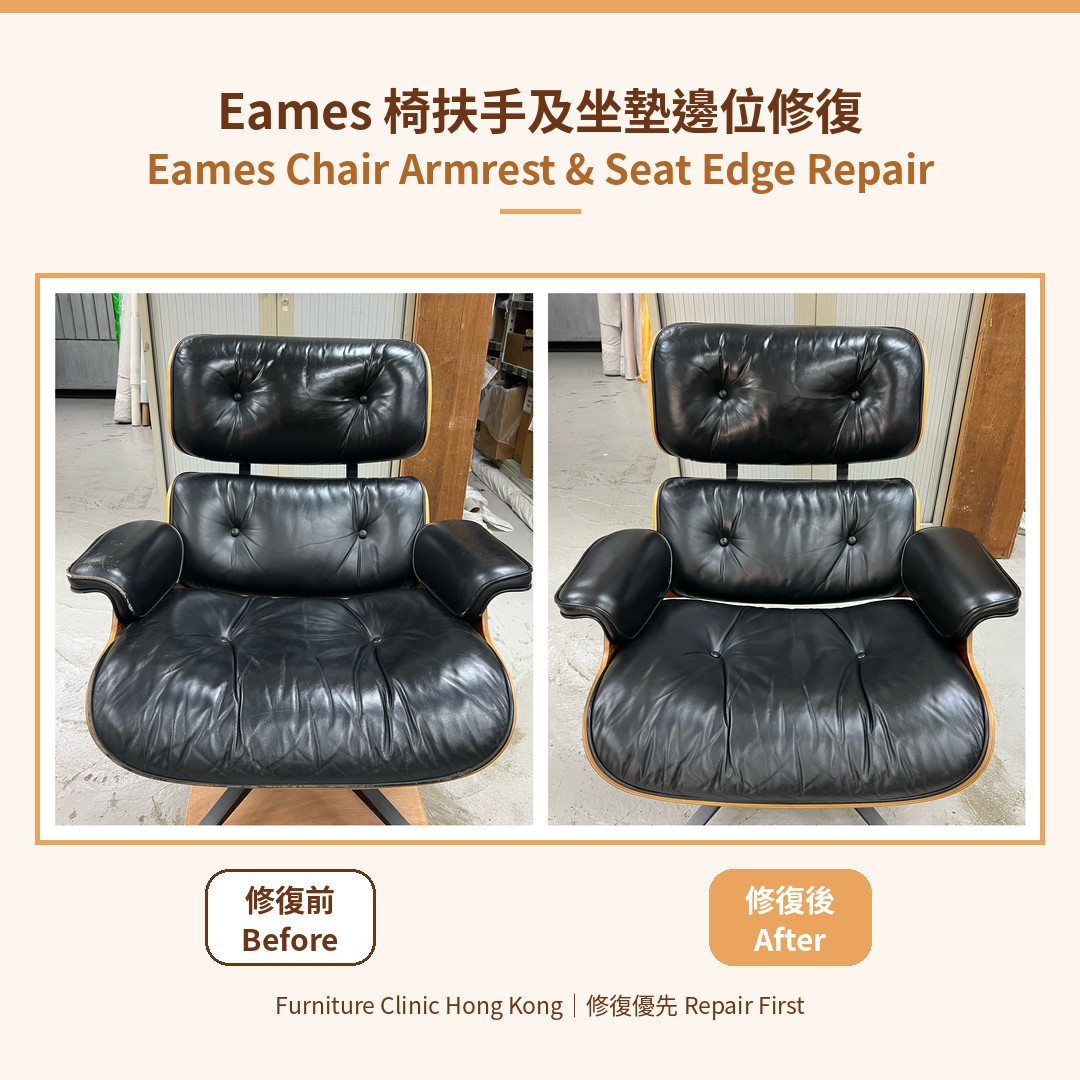
The leather on this black Eames chair was still intact overall. The problems were concentrated on the edges that get the most friction: the armrest fronts, the armrest piping and the cushion edges. We repaired these areas, then gave the whole chair an overall repair for a consistent colour.
| Problem | Location | Repair method |
|---|---|---|
| Cracking and colour loss | Armrest fronts | Remove loose coating, filling, re-colouring, protective finish |
| Worn piping, light core showing | Armrest piping | Fibre strengthening, piping repair, re-colouring, protective finish |
| Worn piping, leather underlayer showing | Cushion edges along the plywood shell | Fibre strengthening, piping repair, re-colouring, protective finish |
| Light wear, uneven colour | Whole chair | Overall repair, re-colouring, protective finish |
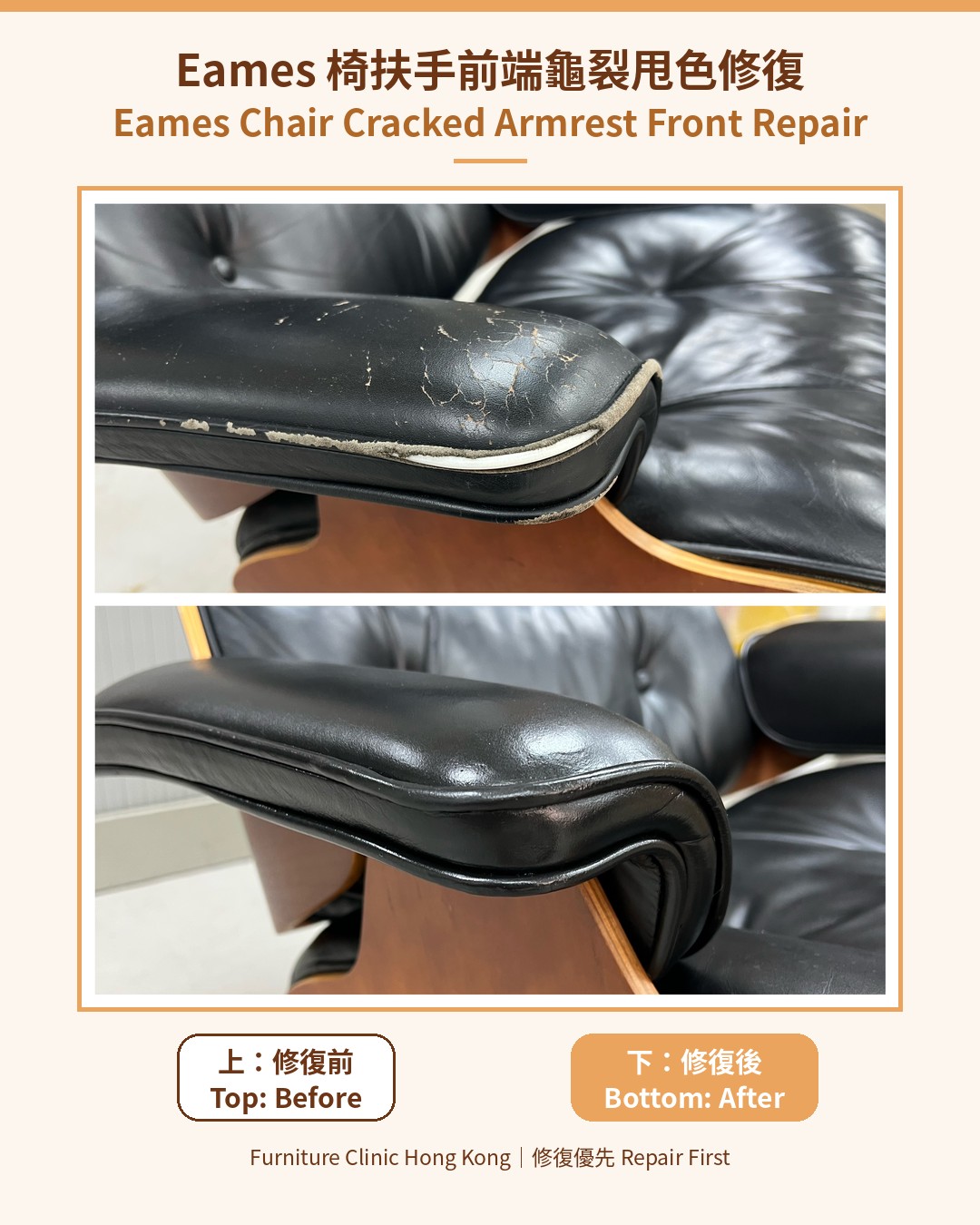
Problem: The leather on the armrest fronts was cracked and losing colour, and the piping was worn through to the light-coloured layer underneath.
Cause: The armrest fronts are where hands press and rub most when getting up. The surface coating wears thin first, then cracks and loses colour.
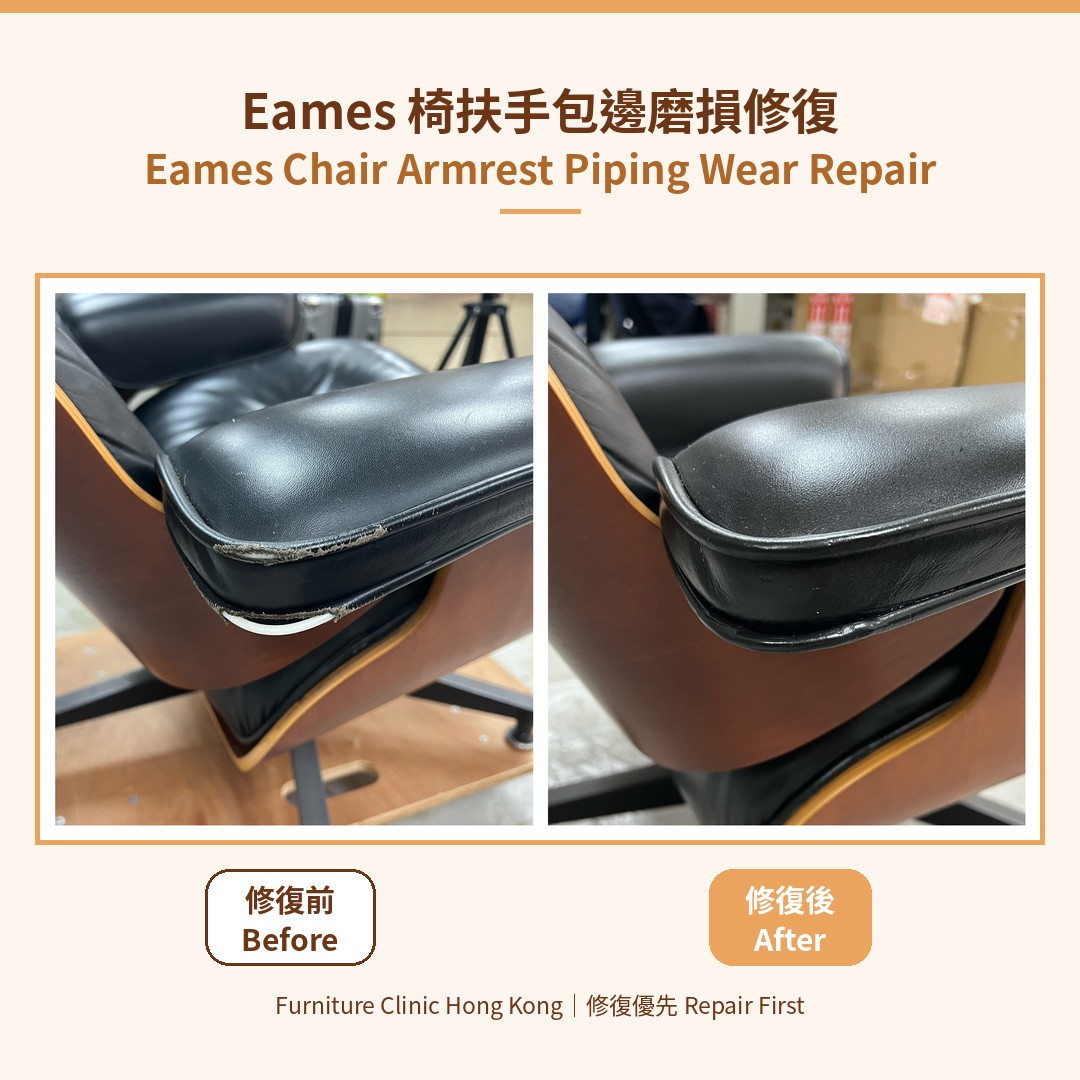
Problem: The outer piping on the armrest had worn through, exposing the white core, and the leather along the edge was flaking off as powder.
Cause: The piping is the most prominent part of the armrest and rubs against arms, clothing and walls over time, so it is usually the first part to wear through.
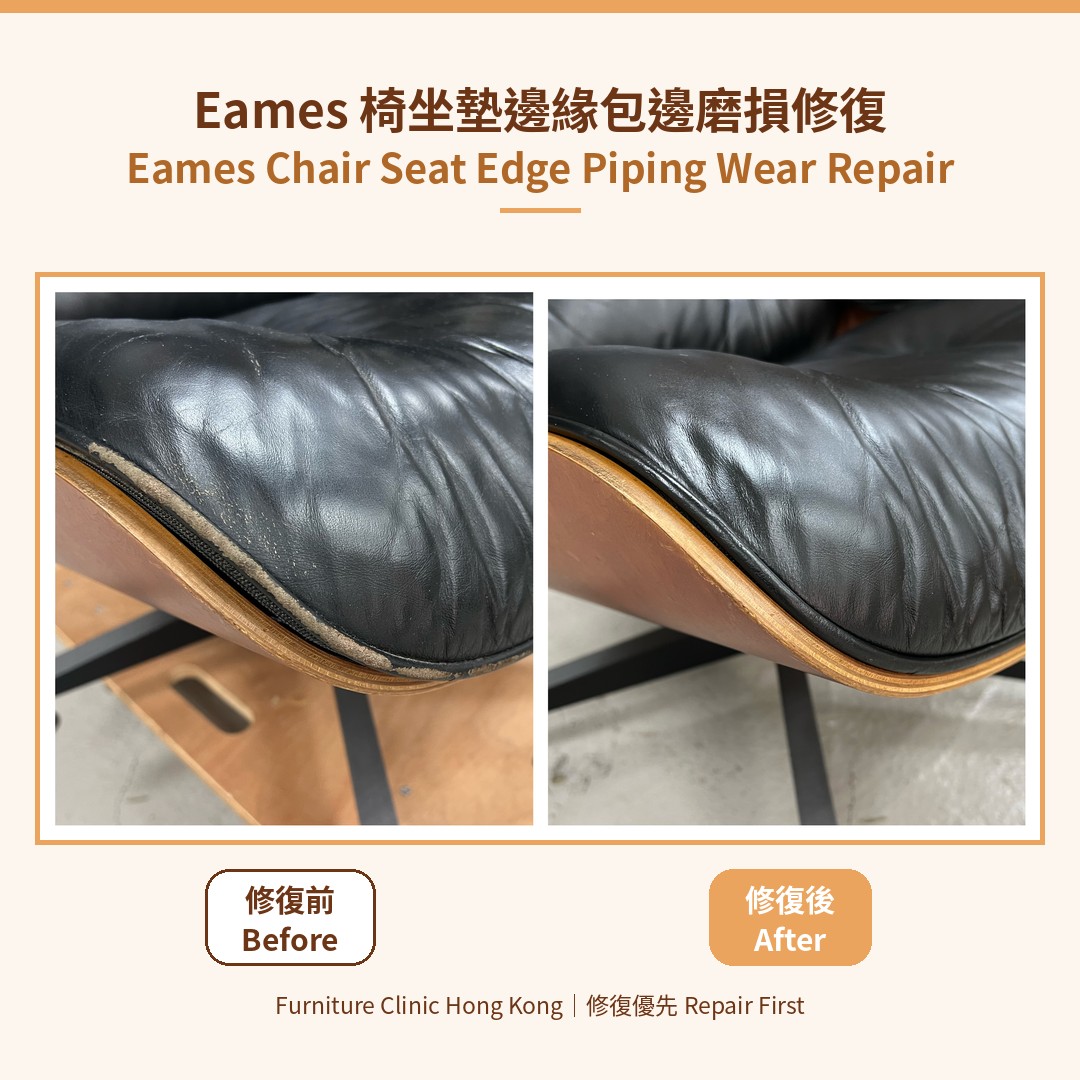
Problem: Along the plywood shell, the piping on the cushion edges was worn down to the light-coloured leather underlayer.
Cause: The cushion edges are rubbed repeatedly by legs and clothing when sitting down and getting up.
Location: Workshop
Result: The armrest and cushion edges were back to an intact black, the whole chair had a consistent colour, and the leather kept its natural look.
Key point: Worn piping and edge colour loss are usually wear of the surface coating and do not necessarily mean the whole piece of leather is ruined. Once an edge wears through, the wear spreads inwards, so the earlier it is repaired, the smaller the repair area.
Case summary
- Problem: Large-scale peeling on the seat cushion and armrests of a replica
- Method: Removing the peeling layer, fibre strengthening, filling, full re-colour, protective finishing
- Location: Workshop
- Result: Even brown colour and smooth leather restored
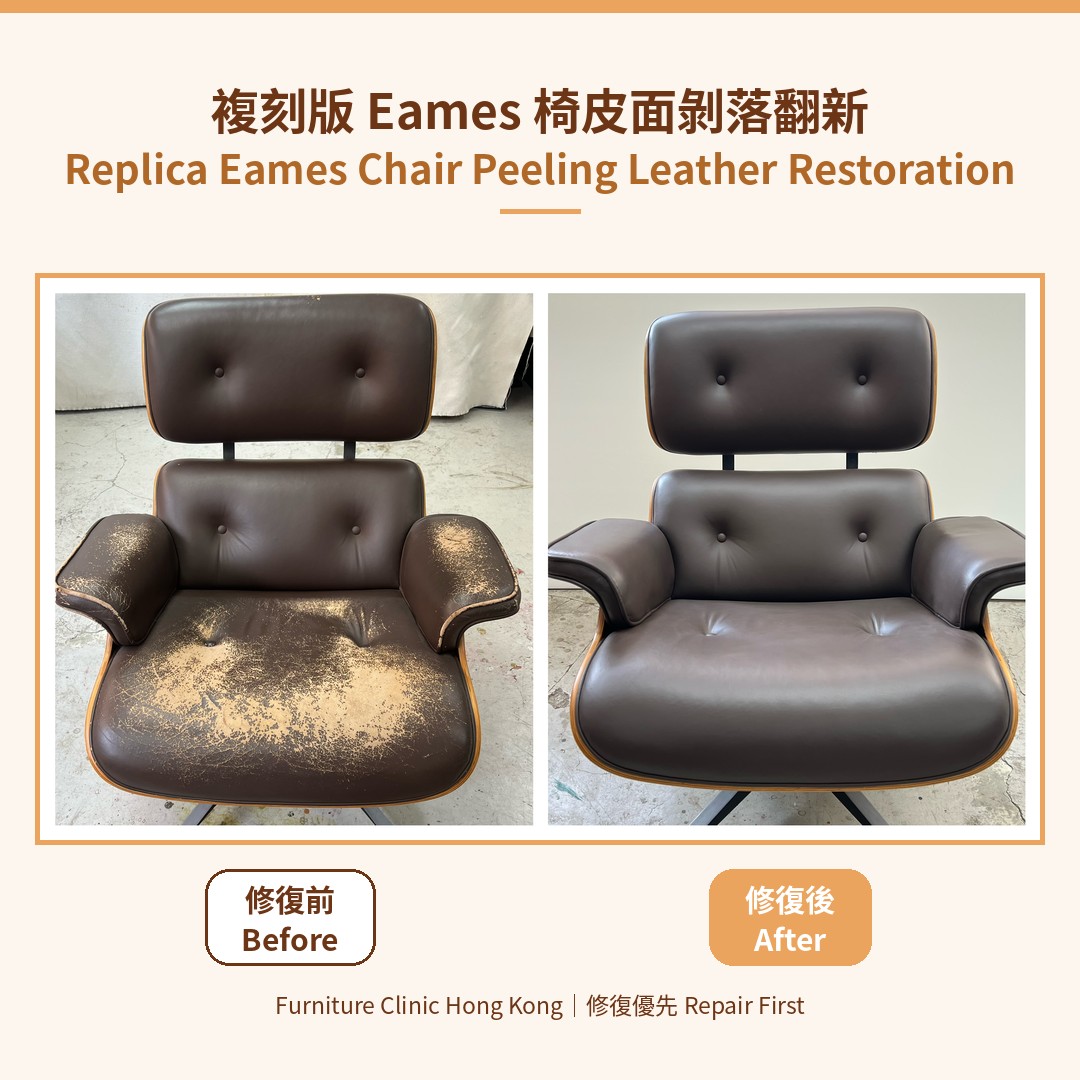
Many owners in Hong Kong have a replica Eames chair. Our technicians have a saying: “Leather is leather.” Whatever the brand, or with no brand at all, the repair method is the same. We assess the leather type and the extent of the damage, rather than letting the brand decide whether a chair can be repaired. This case shows exactly that. For the owner, a chair that has been with them for years is worth more than its brand.
Problem: On the seat cushion and both armrests of this brown replica Eames chair, the colour layer had cracked and peeled over large areas, exposing the light-coloured leather underneath, and the armrest piping was badly worn. The headrest and backrest were in relatively good condition.
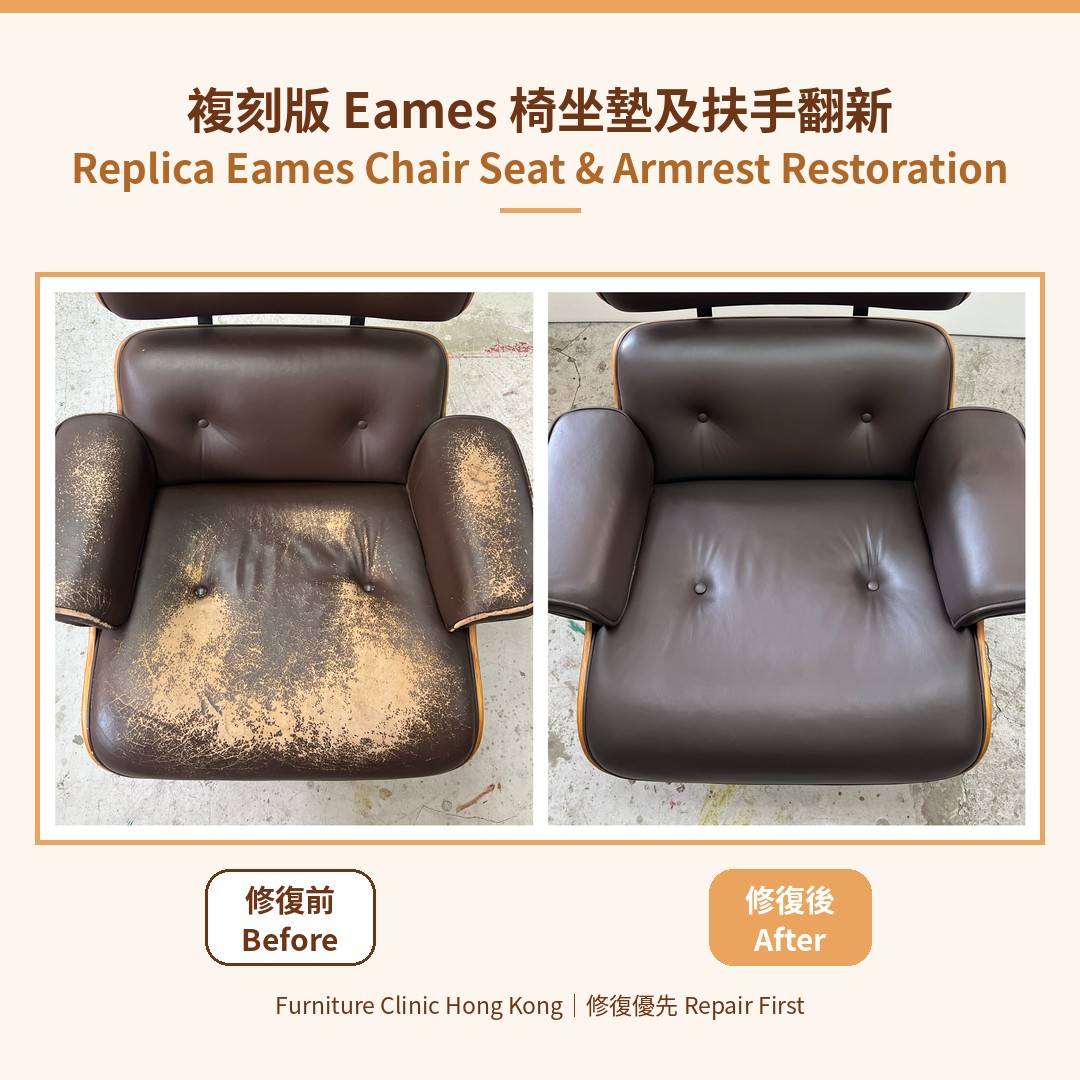
Cause: The seat cushion and armrests take the most pressure and friction on the chair. When the colour layer wears thin over time without protection, fine cracks develop into large-scale cracking and peeling. The headrest and backrest are touched less, so they show much less wear.
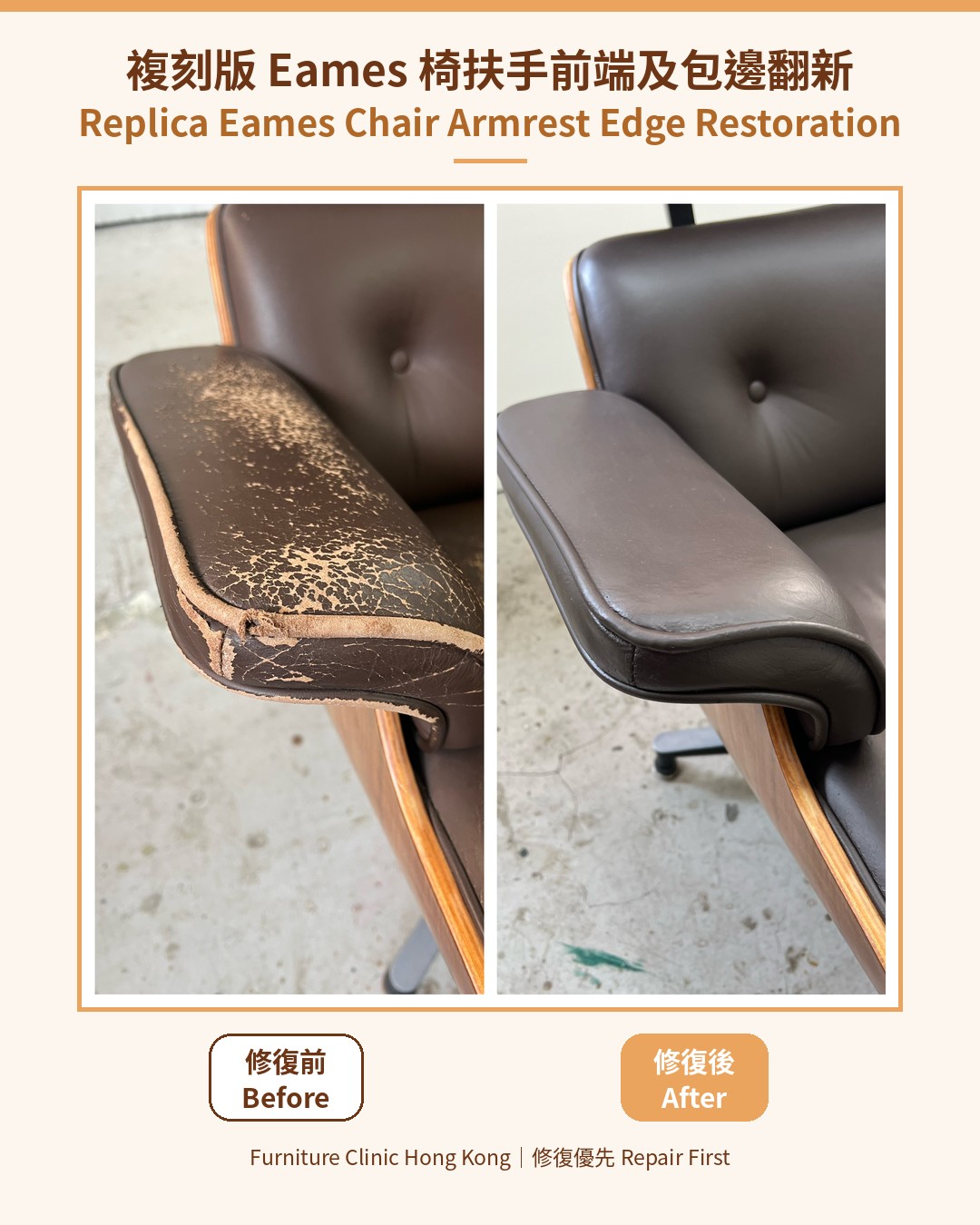
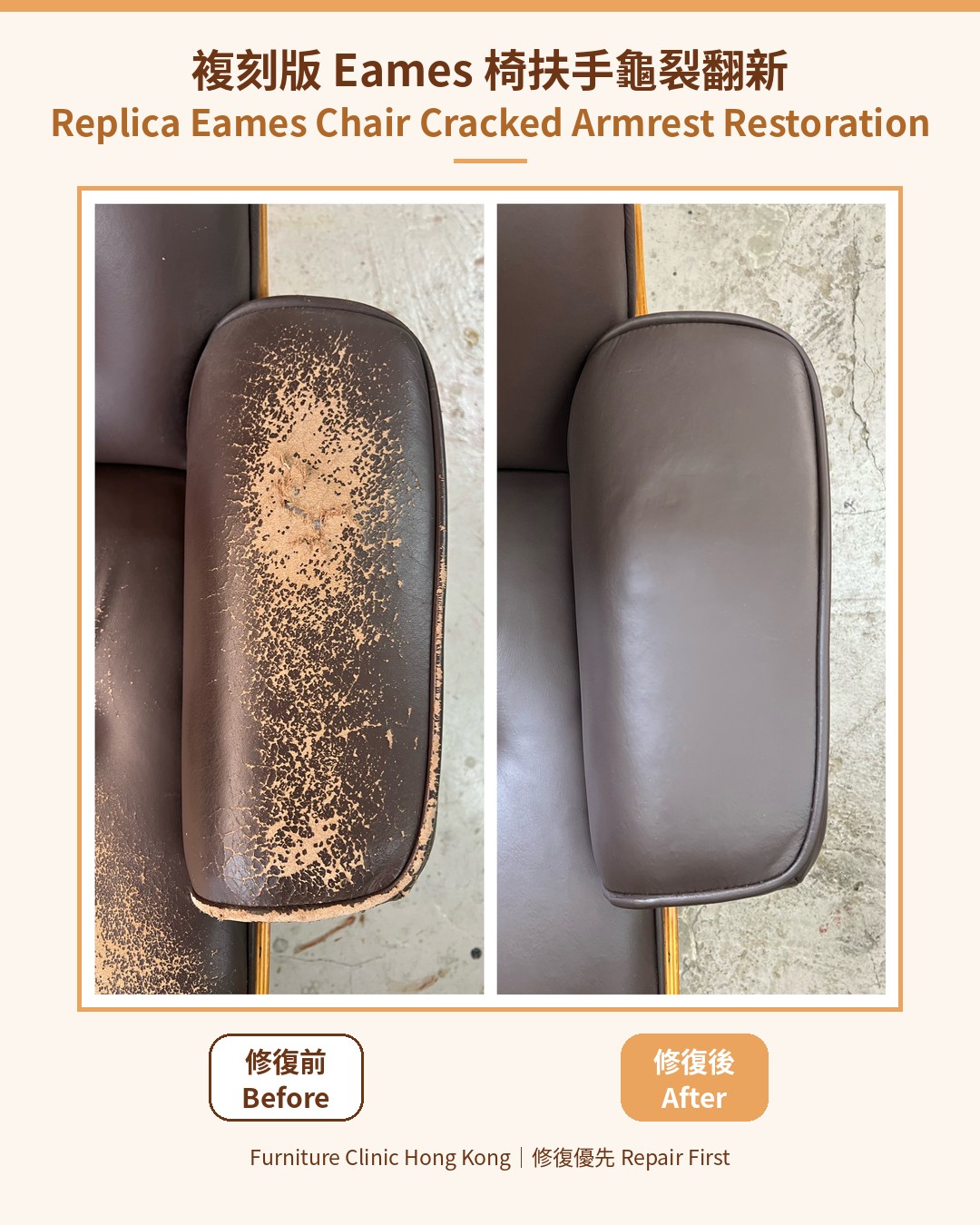
Repair method:
Location: Workshop (large areas of wear and holes need to be repaired in the workshop)
Result: With the peeling on the seat cushion and armrests repaired, the whole chair was back to an even brown with smooth leather, and the armrest piping was restored.
Key points:
| Comparison | On-site | Workshop |
|---|---|---|
| Suitable for | Leather cleaning, mould removal | Large areas of wear, holes, colour-loss repair, detached armrests, button reinstallation, or any work taking more than one day |
| Usual time needed | Completed within one day | Usually 2 to 3 weeks |
| Transport | Not needed | An Eames chair fits in a van, so transport costs are relatively modest (charged separately) |
Why does an Eames chair suit workshop repair? An Eames chair is not large and can go straight into a van, so transport costs are relatively modest. Two-seater and three-seater sofas, on the other hand, cost more to move, so they are usually repaired on-site rather than brought back to the workshop.
All 5 cases in this article were repaired in the workshop, because every chair needed more than cleaning: button reinstallation, mould treatment, re-fixing an armrest, repairs in several places or a large-scale restoration.
| Comparison | Local repair | Full re-upholstery | Buying a new chair |
|---|---|---|---|
| Suitable when | Detached armrests, mould, scratches, colour loss, holes, loose buttons, large-scale peeling | You want a different leather | You want a different style |
| Original leather kept | Yes | No | Not applicable |
| Original chair body kept | Yes | Yes | No |
| Still original? | Yes | No, the leather has been replaced | Not applicable |
| Scope of work | Only damaged areas | All cushions re-covered | Whole chair replaced |
| Materials discarded | Minimal | Old leather | The whole old chair |
| Colour consistency | Requires professional colour matching | New leather is uniform | New chair is uniform |
Does an Eames chair need re-upholstering? Based on our experience with a large number of Eames chairs, Eames chair leather can be repaired, including large-scale peeling on the seat cushion and armrests like Case 5 in this article. Re-upholstery only suits owners who want a different leather; it is not a necessary option for repairing damage.
We have handled many Eames chair cases and our technicians are highly experienced. If you send us enough photos, we can assess and quote, and an on-site inspection is rarely needed.
After the repair: Ideally, let the coating rest for 24 hours before use. The coating continues to cure over the next seven days, so please do not clean the leather or apply other products during that time.
Good care is the simplest way to keep your Eames chair with you for life.
Q1: My Eames chair armrest has come off. Can it be repaired? Yes, and it is very common. Eames chair armrests are originally glued in place and come apart after years of load and adhesive ageing. The repair is to remove the old adhesive, re-glue with a high-strength structural adhesive, then re-tighten the screws in their original positions. Usually there is no need to replace the armrest or the chair body. Because the joint has to take repeated force, it is best left to a professional technician.
Q2: My Eames chair leather has gone mouldy. Can it be repaired? Yes. Surface mould is a cleaning issue that you can handle yourself with Mould Remover and Leather Ultra Clean. If the mould has damaged the pigment layer, it is no longer a cleaning issue but a leather repair, and the leather needs colour matching and re-colouring to cover the mould marks. Afterwards, improve where the chair is kept to reduce the chance of mould returning.
Q3: Does a hole in an Eames chair armrest mean re-upholstering? Not necessarily. If the hole is local, it can be repaired with fibre strengthening, filling and re-colouring, without re-covering the whole armrest. The earlier a hole is repaired, the better the result usually is; the longer it is left, the more the foam underneath gets crushed and the more hand oils soak in and darken the leather.
Q4: My Eames chair leather is peeling and cracking over large areas. Does it need re-upholstering? No. In our experience, Eames chair leather can be repaired. Large-scale peeling can be restored by removing the peeling layer, strengthening the fibres, filling and then re-colouring, while keeping the original leather. Case 5 in this article is an example.
Q5: My white Eames chair has turned grey or yellow. Can it be restored? If the discolouration is surface dirt, deep cleaning usually makes a clear improvement. If the surface coating has aged or the leather is stained, re-colouring may be needed.
Q6: Can a replica Eames chair be repaired? Yes. “Leather is leather”: genuine, replica or unbranded, the repair method is the same. Case 5 in this article is a replica Eames chair with large-scale peeling that was restored to an even finish through repair and re-colouring. We assess whether a chair is suitable for repair based on the leather type and the extent of the damage.
Q7: How long does an Eames chair repair take? On-site or workshop? Leather cleaning and mould removal are usually completed within one day, either on-site or in the workshop. Work that takes more than a day, such as large areas of wear, holes or detached armrests, is best done in the workshop and usually takes 2 to 3 weeks. An Eames chair fits in a van, so transport costs are relatively modest.
Q8: Will the repaired colour differ from the original leather? Our technicians mix the colour to match the original leather so the repair blends with the surrounding surface. Our repairs focus on practicality and durability; the leather grain is not recreated.
Q9: Is the repair guaranteed? Leather repair work comes with a three-month workmanship warranty. If the original repair fails because of workmanship, we will redo it free of charge. Cleaning services are not covered.
Q10: Can I repair an Eames chair myself? Dirt, surface mould, small scratches or light colour loss can be handled yourself with professional leather cleaning, colouring and protection products. Mould that has damaged the pigment layer, large areas of wear and holes are best left to a professional technician, to avoid damaging a design classic. Loose buttons and detached armrests are structural problems and are also best left to a professional technician.
Q11: How many years can Eames chair leather last? The leather on Eames chairs and on car seats mostly has a pigment coating on the surface, so the two are similar in nature. In our experience, with regular cleaning and care, and by dealing with damage early, the leather can last for decades, just like the well-kept original leather seats in classic cars.
Q12: A button has come off my Eames chair and I have lost it. What can I do? If a button comes off, please try to keep it somewhere safe and hand it to the professional team at the time of repair. Even if the button really is lost, we can replace it for you.
Q13: My cat has scratched my Eames chair. Can it be repaired? Yes. Cat scratches are surface leather damage and can be repaired through cleaning, removing the old coating, fibre strengthening, filling and re-colouring, without re-upholstering. In Case 3 of this article, the cat scratches on the right armrest and headrest were restored to smooth black leather.
An Eames chair may be a gift you gave yourself, or a memory left by your family. Rather than replacing it, have it repaired so it can stay with you.
Furniture Clinic Hong Kong has provided leather repair services since 2016 and has completed over 1,300 repair cases. We believe in “Repair first: leather furniture does not need to be replaced lightly.”
Send us photos of your Eames chair on WhatsApp for a free initial assessment.
Further reading:

We use cookies to make your experience better. Using our site means you agree to the use of cookies and similar technologies.